 Loading... Please wait...

- Home
- Rodeo Jewelers Blog
- Lab Grown Diamond Price Drops
Rodeo Jewelers Blog
Recent Posts
Moissanite Diamonds: Pros, Cons & Price Guide
Posted on
Moissanite diamonds are lab-grown stones made from silicon carbide rather than carbon. They look remarkably close to mined diamonds on the hand, sparkle harder under light, and cost a small fraction of the price. The trade-offs are real though, and they matter most when resale value enters the conversation.
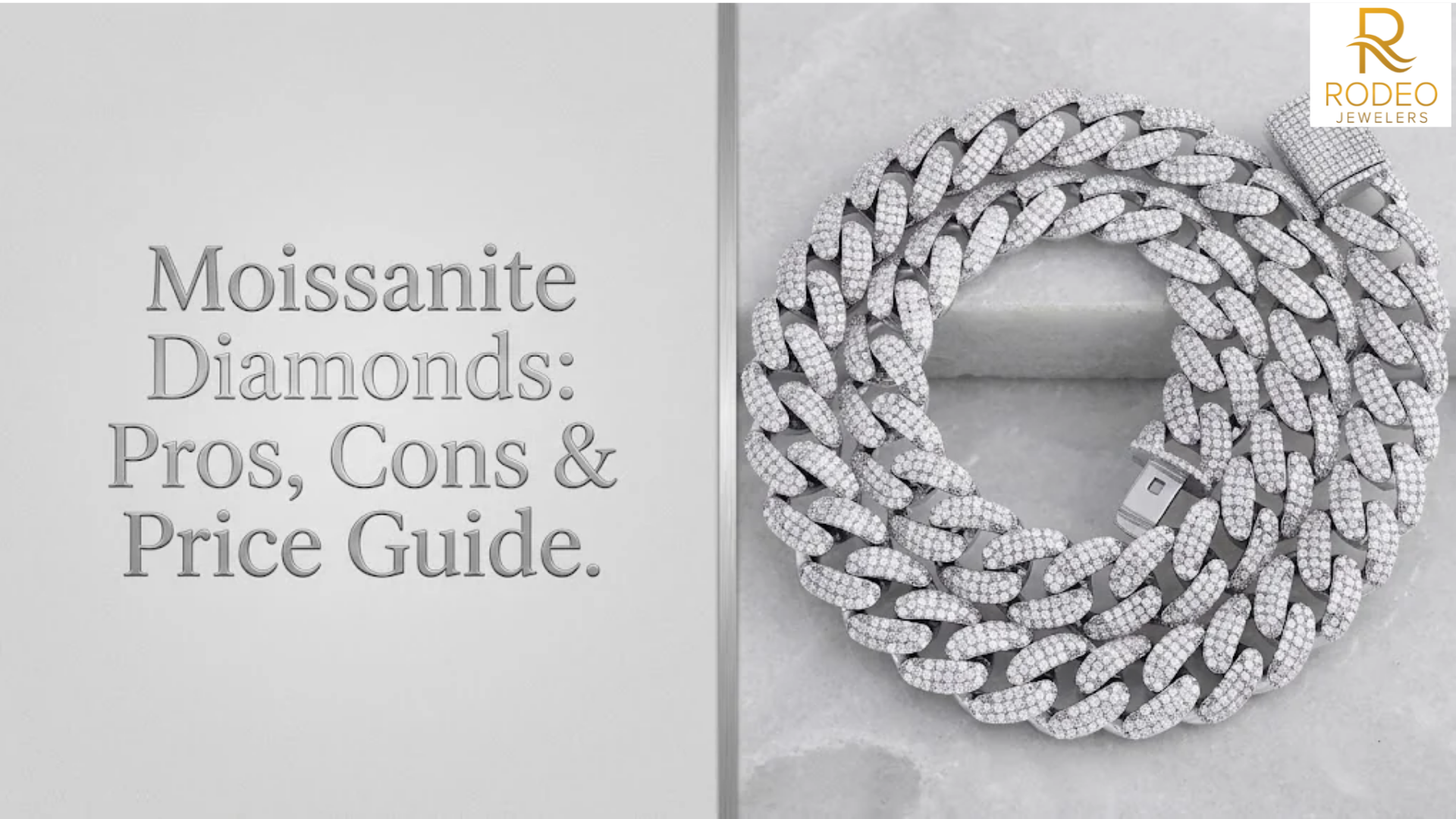
Selling from 1128 Southlake Mall in Morrow, Georgia, Rodeo Jewelers carries moissanite chains and bracelets alongside diamond engagement rings, bridal sets, gold jewelry, and luxury watches. Seeing both stone types side by side under the same showroom lighting answers the question faster than any article possibly can.
What Moissanite Diamonds Are and How They Are Made
Moissanite was first discovered inside a meteor crater, which explains the occasional marketing claim about stardust. Natural supply proved far too scarce for jewelry use, so everything sold today is grown in a laboratory instead. The material is silicon carbide, a genuinely different compound from the carbon forming every diamond.
Cubic zirconia and white sapphire are simulants, meaning they imitate diamond using cheaper materials that scratch and cloud over time. Moissanite behaves completely differently from those stones. It is a genuine mineral with its own identity, optical properties, and hardness close to diamond.
Pros of Moissanite Diamonds
The advantages explain why moissanite has moved from a budget alternative into a mainstream choice over the past decade. Buyers increasingly choose it deliberately rather than settling for it. Five genuine strengths below drive most of those purchasing decisions, and each one holds up in daily wear.
-
Costs a fraction of an equivalent diamond
-
Sparkles harder with more rainbow fire
-
Rates about 9.25 on the Mohs scale
-
Never clouds, dulls or loses shine
-
Grown in a lab with traceable origin
Why the Price Difference Is So Large
Production explains most of it. Laboratories grow moissanite consistently rather than depending on mining output, exploration costs, or supply controls. A moissanite stone commonly costs a small fraction of a mined diamond at similar size and quality, and that saving often funds a noticeably larger center stone instead.
Cons of Moissanite Diamonds
The drawbacks deserve equal attention, because nobody benefits from discovering them afterward. None of these make moissanite a poor choice, though some buyers care more about each one than others. Four honest weaknesses below cover what people most often wish somebody had explained before buying.
-
Very little resale value exists
-
Extra fire looks too flashy for some
-
Larger stones show the difference clearly
-
Lacks the tradition some buyers want
Why Resale Value Stays So Low
No established secondhand market exists for moissanite, unlike diamonds which trade through jewelers, auction houses and private buyers worldwide. Prices have also fallen steadily as production improved, which means a stone bought today may be worth less in a decade rather than holding steady at all.
How the Extra Fire Divides Opinion
Moissanite bends light more strongly than diamond, producing flashes of rainbow color rather than white brilliance. Some buyers love that immediately and choose it for exactly that reason. Others find it reads less subtle, particularly in larger stones above two carats where the effect becomes unmistakable.
What Moissanite Diamonds Cost Compared with Diamonds
Pricing follows carat weight, cut quality and color grade exactly as diamonds do. The gap between the two stones widens as size increases, so a three carat moissanite saves considerably more in absolute terms than a half carat one does. Settings, metal, and certification all add separately to the total.
Carat weight matters most, followed by cut precision. Color grades run from near colorless to faint tints, and clearer grades cost more. Branded moissanite carrying certification typically prices above generic stones, which is worth knowing before comparing two apparently identical pieces offered by different sellers.
How Lab Grown Diamonds Changed the Comparison
Lab grown diamond prices have fallen sharply over recent years, narrowing the gap moissanite once owned alone. A lab diamond is chemically similar to a mined one, satisfying buyers who want a real diamond. Are Moissanite Diamonds Worth Buying now depends partly on where lab diamond pricing sits.
Why Compare Moissanite and Diamonds at Rodeo Jewelers
Photographs flatten the difference between these stones almost completely. Seeing moissanite and diamond together under real showroom lighting settles opinions within seconds. Rodeo Jewelers stocks both, and our staff shows them honestly rather than steering anybody toward one. Sizing and custom work happen in store too.
Conclusion
Moissanite diamonds deliver genuine hardness, dramatic sparkle and a price far below mined stones. The honest cost is resale value and a look some buyers find too bright. Neither choice is wrong. The team at Rodeo Jewelers can show both stones side by side before anything gets decided.
FAQ 1: Does moissanite scratch or cloud over time?
A: No. Moissanite sits at about 9.25 on the Mohs scale, so it resists scratching well and keeps its clarity permanently, unlike cheaper stones such as cubic zirconia.
FAQ 2: Is moissanite cheaper than a lab-grown diamond?
A: Usually yes, though the gap has narrowed as lab diamond prices have fallen. Lab diamonds are chemically similar to mined stones, which some buyers prefer.